


Bengaluru : On International Literacy Day, Vedanta Group highlights its efforts to build learning pathways for over 6 lakh children and youth across India, with more than 50% female participation, through education initiatives spanning over 15,000 Nand Ghars and 500 schools and community learning centres. From early childhood development and foundational learning to STEM education, digital learning, mentorship, competitive-examination preparation and vocational skilling, Vedanta is working to ensure that a child’s circumstances do not determine the limits of their aspirations.
Vedanta’s approach is built around a three-pronged learning pathway: 1) Building Strong Foundations through early childhood education, foundational learning, nutrition and health; 2) Enabling Learning and Aspiration through academic support, remedial teaching, technology, mentorship and exposure to new fields; and 3) Creating Opportunities by connecting education with higher education, competitive examinations, vocational skills, employability and livelihoods. Working with government institutions, schools, teachers, communities and implementation partners, the Group is strengthening learning outcomes, helping reduce school dropout rates and creating pathways that connect early learning to foundational skills, academic progression to higher education, and education to skills and employment, with a focus on children and young people from rural, tribal and underserved communities.
Building Strong Foundations
The learning journey begins in the early years, when strong foundations in education, nutrition, health and social development can shape a child’s future.
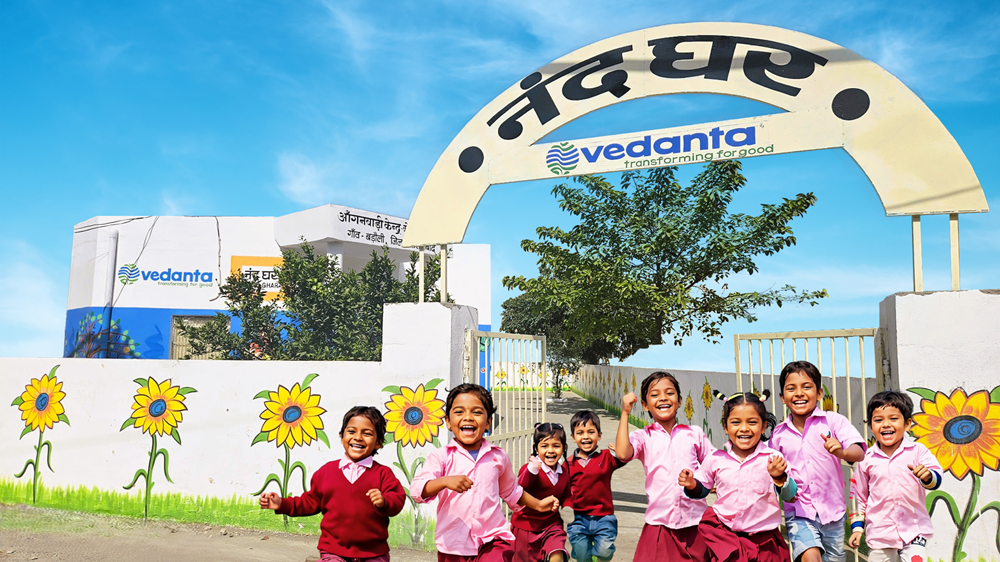
Through Nand Ghar, Vedanta’s flagship social impact initiative focused on modernising Anganwadis into holistic centres of development, the Group integrates early childhood education, nutrition, healthcare and women’s empowerment through over 15,000 centres across 18 states, reaching nearly 5 lakh children and 4 lakh women. While child education and development remain the focus in the first half of the day, Nand Ghars also function as community learning spaces in the second half. Women and adolescent girls can access curated content on English speaking, life skills, government scheme linkages and awareness. The initiative also focuses on strengthening frontline capacity by training Anganwadi workers.
By bringing together education, nutrition, health and community participation, Nand Ghar seeks to create an environment where children can enter their formal learning journey with stronger foundations, while empowering women and communities to play a greater role in their development.
Enabling Learning and Aspiration
As children progress through school, access to academic support, remedial teaching, technology, mentorship and exposure to new fields can help them recognise and pursue opportunities beyond their immediate circumstances.
At Hindustan Zinc, a subsidiary of Vedanta Limited, Shiksha Sambal reached over 13,000 students across government schools in FY26, providing academic and remedial support to strengthen learning outcomes with a pass percentage of 96%. Its Unchi Udaan programme takes this pathway further by supporting students preparing for competitive examinations and higher education. Five students secured over 95 percentile in JEE Main, including a highest score of 99.23 percentile.
Vedanta is also expanding access to future-ready learning. Advanced STEM labs equipped with AI-enabled panels and AR/VR tools are giving students exposure to emerging technologies and new ways of learning.
One such journey is that of Nirma Kunwar from Debari, Udaipur. The daughter of a farmer, Nirma was introduced to Unchi Udaan while attending a Shiksha Sambal summer camp. With structured mentorship and a disciplined learning environment, she went on to score 92.40% in Class 12, earn the Gargi Award and secure a 96 percentile in JEE. She subsequently gained admission to MNIT Jaipur to study Civil Engineering and, after graduation, secured a placement with a leading conglomerate. Her journey illustrates how timely access to academic support, mentorship and opportunity can help turn potential into possibility.
Across other locations, Vedanta is using technology and community-based models to widen access to quality learning. In Odisha, Ekal Schools supported by Vedanta Aluminium, Jharsuguda benefit over 10,000 children, while digital initiatives including Project Vidyagraha and the Gyan Jyoti Digital Education Project are expanding access to educational content and technology. In Kalahandi, Odisha, DAV Vedanta International School, the first English-medium school in the district, provides education to students, around 85% of whom are from tribal communities.
Creating Opportunities
The pathway does not end with literacy or school education. Vedanta’s initiatives increasingly focus on helping young people translate education into skills, employability and livelihoods.
At Vedanta Aluminium’s BALCO, students receive support for competitive-examination preparation, while its Vedanta Skill School equips youth with market-linked vocational skills and supports them towards employment opportunities. At Vedanta Iron & Steel’s ESL Steel Limited, 100% of Class 10 students supported through its education programme cleared their board examinations, with 84% securing first division.
Together, these interventions reflect Vedanta’s broader belief that literacy and learning must ultimately translate into opportunity. On International Literacy Day, Vedanta reaffirms its commitment to strengthening this continuum and creating learning pathways that help the next generation build the knowledge, confidence and skills to shape their own futures.
Disclaimer: This press release contains “forward-looking statements” – that is, statements related to future, not past, events. In this context, forward-looking statements often address our expected future business and financial performance, and often contain words such as “expects,” “anticipates,” “intends,” “plans,” “believes,” “seeks,” “should” or “will.” Forward-looking statements by their nature address matters that are, to different degrees, uncertain. For us, uncertainties arise from the behaviour of financial and metals markets including the London Metal Exchange, fluctuations in interest and or exchange rates and metal prices; from future integration of acquired businesses; and from numerous other matters of national, regional, and global scale, including those of a political, economic, business, competitive or regulatory nature. These uncertainties may cause our actual future results to be materially different than those expressed in our forward-looking statements. We do not undertake to update our forward-looking statements.
