

The prestigious ISDE India Edition 2026, showcases breakthroughs in Minimally Invasive, Organ-Preservation & Targeted Therapies for Esophageal Cancer

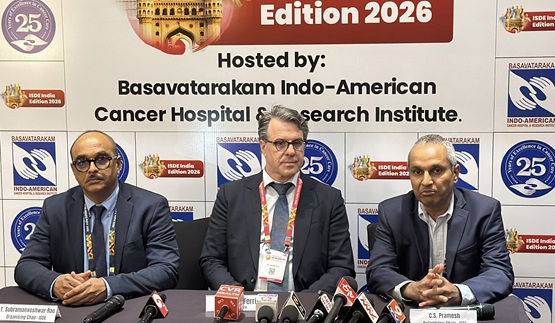
Hyderabad : The International Society for Diseases of the Esophagus (ISDE), in association with Basavatarakam Indo-American Cancer Hospital & Research Institute (BIACH & RI), is hosting the prestigious two-day international conference, ISDE India Edition 2026, at The Westin Hyderabad, Madhapur. Underscoring India’s growing prominence in esophageal cancer research, innovation, and clinical expertise, the conference will be inaugurated by Shri Nandamuri Balakrishna, Chairman & Managing Trustee, NBTRMCF.
Being hosted in India for the first time, the conference will be held on April 10 and 11, 2026, bringing together over 150 oncologists from across the globe. Renowned experts from countries including Canada, Singapore, Japan, Australia, and the USA will join leading Indian clinicians and researchers to exchange insights and advancements. The event also coincides with the Silver Jubilee of Basavatarakam Indo-American Cancer Hospital & Research Institute, one of India’s premier cancer care institutions.
Esophageal cancer remains one of the most aggressive and underdiagnosed malignancies worldwide, with India contributing significantly to the global burden. The disease arises from the lining of the esophagus and is linked to risk factors such as tobacco use, alcohol consumption, GERD, obesity, poor diet, and infections. In India, additional factors such as consumption of very hot beverages and malnutrition further increase risk. The cancer ranks among the top ten globally, with rising incidence in states like Andhra Pradesh and Telangana, and higher prevalence in regions such as the North-East and Kashmir. It significantly impacts swallowing, nutrition, and overall quality of life. Prevention focuses on risk reduction and healthy lifestyle choices, while treatment includes surgery, chemotherapy, radiotherapy, and targeted or immunotherapy, supported by increasingly accessible advanced diagnostics and minimally invasive techniques.
Prof. Lorenzo Ferri, President, ISDE and Director, Upper GI Cancer Program, McGill University, Canada; said, Esophageal cancer is a highly aggressive disease where precision is critical—there is little room for error, yet immense scope for improvement. The International Society for Diseases of the Esophagus brings together leading experts to exchange knowledge and advance the most effective treatment approaches. India has demonstrated remarkable expertise in managing this condition, and there is much to learn from its clinical experience. At the same time, integrating insights from treatment practices in Western countries and Japan can help refine and strengthen outcomes. While the disease and patient experience remain universal, treatment approaches vary across regions. By sharing best practices and collaborating globally, we can move toward more robust, standardized, and effective care. We are truly impressed by the exceptional quality of esophageal cancer care being delivered in India.
ISDE India Edition 2026 is a defining moment that strengthens India’s position in the global fight against esophageal cancer. By bringing world-class expertise to Hyderabad, the conference ensures that Indian patients and practitioners directly benefit from the latest scientific advances and multidisciplinary approaches, said Dr. T. Subramanyeswara Rao, Medical Director & Chief Surgical Oncologist, BIACH & RI and President, IASO. The esophagus, a vital part of the digestive system, was once among the most challenging sites to treat cancer. Historically, outcomes were poor—nearly nine out of ten patients succumbed to the disease, and many cases went untreated due to a lack of trained specialists. Today, however, advances in technology and specialized care have significantly improved treatment outcomes, though efforts continue to further refine and optimize therapies. With increasing life expectancy, the incidence of cancer is rising. Despite substantial growth in hospitals and oncology infrastructure, the demand for treatment continues to outpace capacity. To help bridge this gap, a 500-bed Basavatarakam Cancer Hospital is being established in Amaravati, Andhra Pradesh, scheduled for inauguration on June 22, 2028. India also holds immense potential as a global hub for healthcare tourism. High-quality cancer care is available at a fraction of international costs—treatment in the United States can be up to 70 times more expensive, and in Singapore around 25 times higher. Promoting medical tourism will not only enhance access to affordable care but also generate employment, attract international patients, and contribute to foreign exchange earnings, he added.
The conference will highlight cutting-edge advancements transforming esophageal cancer care, including minimally invasive and robotic esophagectomy for faster recovery, Endoscopic Submucosal Dissection (ESD) for organ-preserving treatment in early-stage cancers, advanced multimodal therapy protocols for improved survival outcomes, and the integration of translational research to enable more precise, targeted therapies.
Dr. C.S. Pramesh, Director, Tata Memorial Hospital, Mumbai; said, At Tata Memorial Hospital, of the 75,000 patients treated, only 13% are from Mumbai, while 87% travel from across the country for basic cancer care. Nearly 40% discontinue treatment midway due to the high cost of living in the city. Recognizing this gap, a nationwide network of cancer centres was envisioned over 14 years ago to ensure uniform standards of care, regardless of where patients live. With treatment costs supported under the Ayushman Bharat scheme, access and consistency have significantly improved. Leveraging digital tools to accelerate progress, this network—now comprising over 400 centres and treating more than 8.6 lakh new patients annually—also serves as a powerful platform for large-scale cancer research.
According to Dr Pramesh, Research must be contextual to the region it serves. Findings from high-income countries are not always directly applicable in settings like ours, given differences in cost structures and resource availability. To address this, we have built a robust, ready-to-use platform that enables researchers across India to undertake meaningful, locally relevant cancer research. As part of this effort, we will be launching an Esophageal Cancer Study Group within the national grid tomorrow. This initiative will focus on advancing research in esophageal cancer, with the aim of improving treatment outcomes not only in India but globally.
Dr Pramesh added, The incidence of esophageal cancer is relatively lower in urban India but rises significantly in semi-urban, rural, and remote regions. The national incidence stands at about 6.5 per 100,000 population, with higher rates among men which is 8–9 per 100,000 compared to women 3–4 per 100,000. Notably, there are two major hotspots—Kashmir and the North Eastern states, where incidence rates are 6 to 7 times higher than the national average. This variation is driven by multiple factors, including higher tobacco and alcohol consumption, the habit of consuming very hot beverages such as tea, and dietary practices like long-term consumption of smoked and preserved meats. Late detection remains a significant challenge, contributing to poorer treatment outcomes in these regions.
The distinguished international faculty includes Prof. Lorenzo Ferri, President, ISDE and Director, Upper GI Cancer Program, McGill University, Canada; Dr. Ken Kato and Dr. Hiroyuki Daiko from the National Cancer Center Hospital, Japan; Dr. Edward Cheong, Singapore; Dr. Cuong Duong, Australia; and Dr. Steven Lin, USA. Leading Indian experts such as Dr. T. Subramanyeswara Rao, Medical Director & Chief Surgical Oncologist, BIACH & RI and President, IASO, along with Dr. C.S. Pramesh, Director, Tata Memorial Hospital, Mumbai, will provide perspectives tailored to the Indian context. The conference is poised to play a pivotal role in advancing collaboration, knowledge exchange, and clinical excellence in the fight against esophageal cancer.
The Press conference hosted to announce the details of the Conference was addressed by Prof. Lorenzo Ferri, President, ISDE & Director, Division of Thoracic & Upper GI Surgery, McGill University, Canada; Dr. T. Subramanyeshwar Rao, Medical Director, BIACH&RI; President, IASO; President‑Elect, Global Forum of Cancer Surgeons; Dr. C.S. Pramesh, Director, Tata Memorial Hospital, Mumbai; Dr. Senthil Rajappa, Head of Medical Oncology, BIACH&RI; Dr. Ken Kato, President-Elect, ISDE & National Cancer Center Hospital, Tokyo, Japan; Dr. Steven Lin, Radiation Oncologist, MD Anderson, Houston USA; Dr. Hiroyuki Daiko, Esophageal Surgeon, National Cancer Center Hospital, Tokyo, Japan; Dr. Edward Cheong, Upper GI Surgeon, Panasia Surgery, Singapore and Dr. Cuong Duong, Upper GI Surgeon, Peter MacCallum Cancer Centre, Melbourne, Australia.
