

Panel Discussion 3: Next-Gen Biologics & Advanced Modalities: From Discovery to Clinical Proof & CMC at Scale

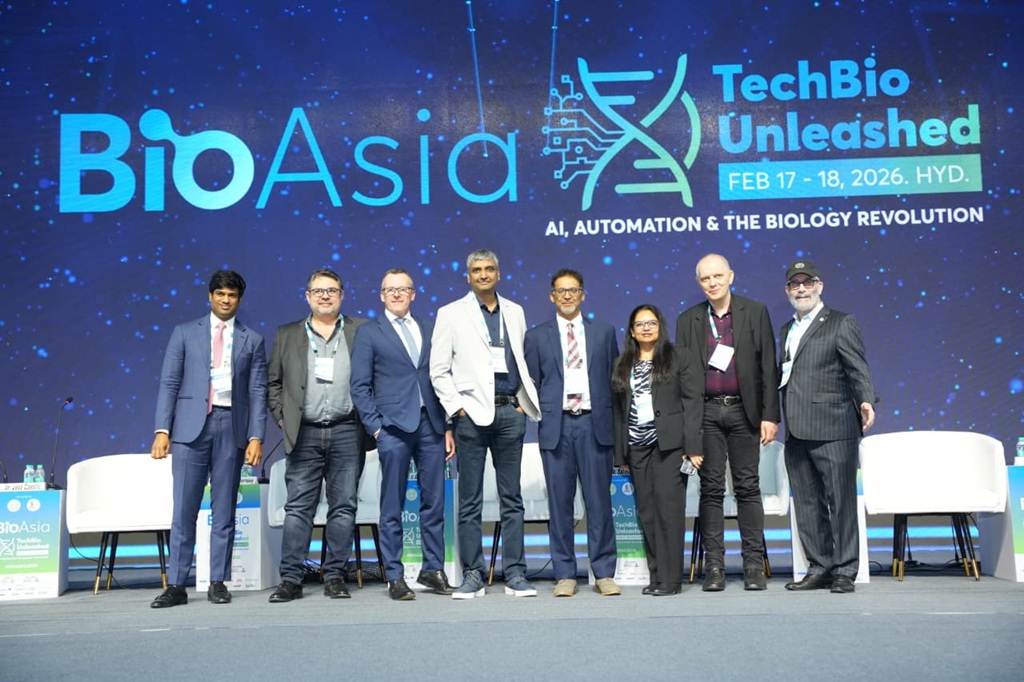
Panel speakers:
* Dr. Raches Ella, Chief Development Officer, Bharat Biotech
* Dr. Darrin Morrissey, CEO, NIBRT, Ireland
* Dr. Sai Praveen Haranath, SVP Medical & Strategy, Apollo Health Axis
* Mr. V Simpson V. Emmanuel, President at ImmunoACT
* Dr. José Castillo, CEO, Quantoom Biosciences, Belgium
* Dr. Madhuri Vusirikala (MD) VP, Actinium Pharmaceuticals, USA
Moderator: Mr. Gil Bashe, Chair Global Health and Purpose, FINN Partners, USA
Summary:
The panel explored how next-generation biologics spanning vaccines, mRNA, cell and gene therapies, radioligand treatments, and advanced bioprocessing are moving from breakthrough science to scalable global impact.
Gil Bashe opened by noting that biologics now represent over 40% of the global pharma market, with more than 2,000 cell and gene therapies in development. The key challenge is no longer discovery, but translation, clinical validation, regulatory alignment, CMC robustness, manufacturing scale, affordability, and equitable access.
Dr. Raches Ella highlighted India’s vaccine leadership, supplying one in three children globally, and advancing late-stage trials in TB, chikungunya, and enteric diseases. He emphasized rapid, science-led responses to emerging pathogens and the need for global manufacturing readiness.
Dr. José Castillo discussed decentralized mRNA platform deployment to ensure regional self-sufficiency, stressing regulatory harmonization and public trust as critical enablers.
Dr. Madhuri Vusirikala showcased radioligand “theranostics,” combining diagnostics with targeted alpha therapies to deliver precision oncology while minimizing systemic toxicity.
Simpson Emmanuel presented India’s humanized CAR-T platform, achieving treatment costs under 10% of global benchmarks and expanding access across 90+ centers, proving affordability and innovation can coexist.
Dr. Sai Praveen Haranath underscored health-system preparedness, digital integration, and remote monitoring to reach underserved populations.
Dr. Darrin Morrissey emphasized manufacturing discipline, skilled workforce development, and global supply chain resilience as foundational to scaling advanced therapies.
The consensus: programmable biology is here, but collaboration, regulatory agility, and manufacturing excellence will determine how quickly innovation reaches patients worldwide.
Below is the full transcription:
(MR.GIL BASHE)
(0:00) A perspective. (0:03) Generally, when panels are put together, there’s a harmonious group of people who are centered around one singular segment of the life science industry. (0:15) This panel is representative of possibility.
(0:20) It deals with people who are dealing with, in fact, everything from the beginning of drug discovery and innovation to its proof points, to the ability to manufacture innovative therapies and then bring them to patients. (0:43) We are looking at the end-to-end from discovery to treating people in the clinic. (0:52) I have to share with you right now that we’re at a defining moment in the history of the life science sector.
(1:00) This is not only for the global biopharmaceutical industry, but for India. (1:08) Biologics now represent more than 40% of the world’s pharmaceutical market. (1:14) There are more than 2,000 cell and gene therapies in development at this moment.
(1:22) Radioligand therapies are redefining precision oncology. (1:26) mRNA platforms are demonstrating that vaccines and therapeutics can be designed in weeks, not years. (1:36) This is actually structural transformation.
(1:42) India stands at the center of this transformation. (1:46) India stands at the center of this transformation. (1:51) I’m very proud that actually three of the members of the panel are based in India, operating in India, discovering, pursuing, and bringing to the market therapies from India.
(2:10) One has been trained in India and has returned to lead one of the largest health systems in this country. (2:20) Another has been trained in India and has had some of the most prestigious fellowships in the world in the area of bone marrow transplantation and is now developing therapies that can treat people for cancers around the world. (2:39) According to the India Department of Biotechnology, the biotech sector in this country has grown from roughly $10 billion in 2024 to more than $150 billion in recent years.
(2:55) And the government, the nation’s ambition is that this country will reach $300 billion by the end of this decade. (3:04) India will become a powerhouse to the world in terms of discovering and bringing forward new therapies. (3:13) I hope that the people in this audience feel very proud by your achievement.
(3:19) The achievement not just to raise possibility in this nation, but to cure and bring hope to people from around the world. (3:28) India is one of the world’s largest vaccine producers and among the top pharmaceutical producers globally by far. (3:35) I think, as a matter of fact, someone told me yesterday that India produces 30% of the vaccines that are used around the world from India.
(3:46) Now, biology is programmable. (3:50) Precision is achievable. (3:52) Artificial intelligence is accelerating discovery.
(3:56) The defining challenge before us is not invention. (4:00) It is translation, clinical proof, CMC rigor, scalable manufacturing, affordability, and global access. (4:11) Today’s panel represents the entire value chain required to solve that equation.
(4:22) I want to just provide a little more context to the panel and then I’m going to ask them a first question if they just go sort of left to right and add a bit of context. (4:34) You know, we often hear about these companies, about what they’re doing. (4:37) The biological aspects.
(4:40) The challenges. (4:41) Regulatory. (4:42) All of that.
(4:46) The real issue is why should we care? (4:50) Why does it matter? (4:52) To whom does it matter?
(4:55) And I think for those of you who are involved in this industry, if you look deep within your heart, within your soul, I hope you believe that whatever you’re doing, you are contributing to saving, sustaining lives. (5:14) At the end of the day, that’s why we’re here. (5:18) There are things that we do to achieve that, but we have to understand that what we do is a collaborative process.
(5:27) It is not a solo pursuit. (5:31) I think that’s what makes India great. (5:33) When I hear about the GCCs, about global capability centers, I think of one thing.
(5:41) People working together to accelerate solutions to life-threatening problems. (5:48) So, I’d just like to start with Rechis and go along the line. (5:54) Let me ask you, why are you here?
(5:58) Why should we care? (6:00) What difference do you hope to make?
(DR. RACHES ELLA)
(6:03) Rechis? (6:03) Thanks for that, Gil. (6:05) I hope you can hear me okay.
(6:07) Why we’re here? (6:09) It’s a very simple mission. (6:10) There are 125 million children born each year.
(6:14) That’s the birth cohort. (6:15) One in three children receive a vaccine that’s produced in India. (6:20) When I say produced, vertically produced.
(6:22) That’s R&D and manufacturing in India. (6:25) Our goal is to touch all the 125 million children in India, and then, of course, also in our next endeavors, develop innovative products towards oncology and auto-recovery.
(DR. JOSE CASTILLO)
(6:41) Please continue, José. (6:44) Sure, thank you. (6:46) Actually, Quantum is a small R&D platform technology company into a very small country.
(6:52) So, if you drive 45 minutes, you are in a different country and people speak a different language. (6:58) So, by nature, we are looking outside of our country. (7:04) Since 2006, we have our first company and our first technology.
(7:10) India has been the most risk-taking country. (7:15) So, this is actually where I sold my very first bioreactors to produce commercial products in this country. (7:22) So, for us, India is a very important market.
(7:24) We have very nice long-term relationships and that’s the reason why I’m here today to promote our R&D technologies.
(DR. DARRIN MORRISSEY)
(7:34) Thanks, Gil. (7:35) Thank you. (7:36) I guess I represent an organization called NIBRT, which is the National Institute for Bioprocessing Research and Training in Dublin, in Ireland.
(7:46) And in many respects, I represent not just the Institute of NIBRT but Ireland on the world stage. (7:54) Ireland has, as a country of 5.5 million, spent the last 25 years plus building up a significant biopharmaceutical manufacturing industry in partnership with FDI companies, multinational companies all over the world. (8:11) We now produce €100 billion worth of exports in biologic medicines annually and we’re the third largest biologics manufacturer in the world.
(8:23) And, I guess, while we’re here, my colleague and I are here representing NIBRT to build partnership. (8:30) We are an institute that’s focused on knowledge development, research and training in biologics manufacturing with an increased focus on next generation and advanced therapeutics. (8:44) And we’re building partnership.
(8:46) We’re engaging with the government of Telangana and we’re engaging with the local region about building a partnership. (8:52) So that’s why we’re here.
(DR. SIMPSON V)
(8:56) Well, I represent the Amino Act. (8:59) The Amino Act is an organization which is very unique because it’s born out of a partnership between academia and as well as the industry because we came out of IIT Bombay and TMH which is the Apex Center for Cancer. (9:17) From lab to commercialization is something which is unique about this and we are the cutting edge of science which is the cell and gene therapies.
(9:26) It’s not just about something which happened in the lab. (9:29) It’s also about how can it actually see the light of the day in terms of providing access to patients. (9:35) So that’s what has been accomplished in terms of commercializing the product over the last two years and more than 600 patients have benefited and have found hope in their lives I could say on something which they might not have any hope on.
(9:53) So this is a great example where we have something which has started off as an innovation from the lab which has got commercialized. (10:02) Right now it’s providing hope to millions because it’s not just an innovation which is very restricted for India because the typical tap is of course in the manufacturing inefficiencies which are seen in cell and gene therapies have been very effectively addressed and right now it’s just not an innovation for India but it’s an innovation for the world. (10:23) And the reason why I’m here is because I believe in the power of collaboration and partnerships because that’s how this organization came to be and what better forum to look at potential partners and look at how to take this forward to provide access to millions across the world.
(DR. SAI PRAVEEN HARANATH)
(11:05) And whatever we do really depends on lives of patients and that’s kind of why we’re here. (11:10) And it’s a reminder as a physician myself that healthcare itself is at an intersection around the world. (11:16) We have these amazing new therapies that can transform lives but they’re out of reach, out of access to many either due to geography or cost and I think the bigger reason is that we sometimes are just not aware of it.
(11:28) So I work at Apollo Hospitals (11:29) Apollo as you know is a very large hospital system (11:31) about 10,000 beds, 75 hospitals across India (11:35) and the regional Apollo that now (11:36) is called Health Access that I’m part of (11:38) and this division’s real mission and vision (11:41) is to be the provider’s provider partner (11:43) so figuring out a way to use (11:45) the learnings we’ve had in India (11:47) across the board (11:48) helping with health IT, virtual care, (11:50) artificial intelligence, direct patient care (11:52) and how can we help other countries (11:54) around the world do that. (11:56) Anytime I give talks like this or in my panels there’s three numbers that really hit me one of them is 28 which is India’s median age of age when you get out there’s about a billion people getting old in India and likewise in Africa in the next 30 years so all the treatments the West is using now are going to be required in these geographies.
(12:15) The second number that really gets me is 4.5 that’s 4.5 billion humans have no access to essential health services so whatever we do we need to reach out to them and the last number of course is one so whatever treatment we invent needs to affect that one patient and that’s kind of why I’m here.
(DR. MADHURI VURSIRIKALA)
(12:33) Thank you. (12:37) I’m a physician and oncologist I did my training in India and then went on to do some further training in the United States. (12:44) Why am I here?
(12:45) Well, I believe I’m in a sweet spot I was a physician an investigator and took care of patients and saw the benefits of innovation directly take effect for patients save their lives improve the quality of their lives and now that I’m in the industry as part of drug development I can help a lot of patients and we are all in that for this reason. (13:12) I work at Actinium Pharmaceuticals a radiopharmaceutical company we make these drugs called radioligand therapies and it’s a rapidly evolving field unfortunately not a whole lot is being done along those lines in India and I believe there is a huge unmet need for radioligand therapies in India and we would like to do some clinical trials and benefit the people of India with that type of therapy. (13:40) Thank you.
(GUEST)
(13:43) Yeah, and I’m really here to work together with scientists clinicians people who run hospitals to bring these therapies here to our patients in India.
(MR.GIL BASHE)
(14:12) I’m having a little bit (14:13) of a sound problem there (14:14) so I wanted to start (14:17) Jose, if I could with you (14:21) thank you for your passion (14:21) for being here (14:22) passion doesn’t mean that you’re (14:24) not without obstacles (14:25) so I wanted to ask you a question (14:27) I think that we would all agree (14:30) that there’s an elephant (14:31) in the room right now (14:33) we often talk about what we’re doing (14:36) and we have to remember (14:37) that of course we’re dealing (14:39) with other issues (14:40) so Jose as a company (14:42) that is involved in developing (14:43) the mRNA platform (14:51) we bring therapies to the market (14:52) in weeks instead of years (14:55) there’s a whole conversation (14:57) a controversy right now (14:59) from the United States (15:00) about the vaccine schedule (15:02) and I’m wondering (15:04) if you could put that into perspective (15:06) for our audience.
(DR. JOSE CASTILLO)
(15:10) Actually this is (15:11) an excellent first question (15:14) for the panel (15:15) actually as I was saying (15:17) our market for a small company (15:20) in a small country (15:23) I must tell you that (15:24) we have today (15:25) 25 already installed (15:29) RNA synthesis (15:31) and production systems (15:32) all over the world (15:33) in South America (15:34) four countries in Africa (15:36) Southeast Asia, India, Australia (15:39) and I don’t see any skepticism (15:42) in the whole world (15:44) I think that (15:45) at some point (15:49) in high income countries (15:51) like in North America (15:53) also in Europe (15:56) probably citizens (15:57) and parents (15:59) don’t have the same perception (16:01) of risk (16:03) after 50, 60, 70 years (16:06) of routine vaccination (16:07) there is really (16:09) probably the perception (16:10) that it’s not useful anymore (16:12) so I think that (16:13) it’s just a matter (16:15) of managing (16:19) the health (16:20) in North America (16:23) and at some point (16:24) I think that science (16:25) will tell us what must be done.
(MR.GIL BASHE)
(16:28) Thank you very much for clarifying that for all of us I think it’s safe to say that you and your company believe in science.
(DR. JOSE CASTILLO)
(16:36) Yeah, at the end we are all supposed to make decisions based on what we observe and what we think the needs are at least this is what we do as a tech company as engineers and so we always try to tune the best possible solution to deliver to our customers that express the need and I think that the same will happen the same approach at the end I think that science will tell us what to do. (17:08) Thank you, thank you very much
(MR.GIL BASHE)
(17:10) So now our panel deals (17:13) with new therapies (17:14) and new therapies (17:23) so we’re dealing with (17:25) some cutting edge issues (17:26) here of science (17:27) Madhuri I wanted to start (17:29) with you if I could (17:30) and you talked about (17:32) ligand therapy (17:33) or radio ligand therapy (17:34) or radiotherapeutics (17:37) to clarify for the audience
(DR. MADHURI VURSIRIKALA)
(17:40) Sure, thanks Gil
(MR.GIL BASHE)
(17:41) One of the most difficult (17:43) aspects I think (17:44) of cancer therapy (17:45) is the toxicity (17:53) and you talked about (17:53) what it is to take a look (17:55) at a new approach (17:56) to treating patients (17:57) what that might mean (17:59) for the patient (17:59) and for the physician (18:01) who’s making that determination
(DR. MADHURI VURSIRIKALA)
(18:05) So before I answer your question (18:06) I want to give a little context (18:08) for our audience (18:09) what is radio ligand therapy (18:11) basically it is (18:12) pairing a targeted molecule (18:14) which could be an antibody (18:23) it is given systemically (18:25) so you actually are (18:26) giving systemic radiation (18:28) in a targeted manner (18:29) so that is the beauty (18:31) of radio ligand therapy (18:35) when we’re talking about (18:36) radio ligand therapy (18:37) there are two aspects to it (18:39) one is the target (18:40) now the target could be (18:42) biologically driven (18:43) or it could be just a mere target (18:45) and the radiation will do the job (18:48) the other beautiful thing (18:53) what does theranostics mean (18:54) it means that you have a ligand (18:56) you use the ligand (18:58) both for imaging (19:00) as well as therapeutic (19:02) so you really know (19:04) whether the patient is expressing (19:06) that target, that ligand (19:07) before you give the therapy (19:09) so you are not working in the blind (19:12) you know that the therapy (19:14) is actually going to work (19:15) for the patient (19:16) given that this is targeted therapy (19:19) you are going to have (19:23) side effects (19:24) so the radiation (19:27) actually goes and (19:28) kills the cancer cells (19:29) where the target is (19:31) and the healthy tissues (19:32) which don’t have the target (19:33) don’t get affected by the radiation (19:35) and especially this DNA (19:37) drugs, radio isotopes (19:40) called alpha emitters (19:41) and they have a very short wavelength (19:43) a short length (19:44) so it’s like one to two cells (19:47) so the surrounding tissue (19:53) is going to have the effect (19:53) we tell our patients (19:54) that they can get this treatment (19:55) and go to the mall (19:57) without actually causing any harm (19:59) to anybody around them
(MR.GIL BASHE)
(20:01) thank you very much (20:02) I just want to swing over to Simpson (20:04) for a second (20:04) because Madhuri (20:08) you are inventing going forward (20:10) and obviously you bring (20:12) all your clinical experience (20:13) as an oncologist (20:14) as someone who is really (20:23) very cutting edge. (20:24) We’ve moved, you know, past the period of question to the period of possibility. (20:30) Could you talk a little bit about CAR-T, talk a little bit about the condition that you’re trying to intervene on?
(20:38) It’s a rare condition, it’s a deadly condition, and where are you going in terms of bringing a wave of new therapies into the hospital systems?
(DR. SIMPSON V)
(20:51) Okay, it’s a very wide subject. (20:54) Primarily, cell and gene therapies or CAR-T therapies (20:56) are not something which is, it’s not an unknown concept, it’s been there for almost 10 years, (21:03) but it’s a radical change from how you would look at a conventional way of treatment, (21:09) because you’re talking about extracting the cells from a person’s body, (21:15) reinstering the T-cells, and activating them, helping them to get, it’s like providing them (21:21) an iron man suit, and then re-infusing them into the body, so that they are able to fight (21:26) the cancers which are there, and again, any kind of problems which the person might be (21:33) having, because if you actually look at this concept, it’s a very intriguing concept, (21:38) but it’s a very difficult concept to grapple with as well, because it’s not just about the (21:45) science and the manufacturing over here, it’s about the access part as well, because the science (21:51) and the discovery is just one small part of the entire process.
(21:55) Here, you would have to break down every cookie-cutter methodology that we have invented for the traditional pharmaceutical marketing. (22:03) You don’t have a distributor, you don’t have a batch manufacturer, everything is personalized. (22:08) Now, it’s a patient who is completely individualized, and you have to target that particular patient.
(22:15) It’s not substitutable with any other patient samples. (22:19) So, if it is going to be that personalized, then you have to think about the entire ecosystem which will have to support that as well. (22:27) So, of course, it’s an intriguing science.
(22:30) We are talking about a huge difference in terms of survival outcomes and progression-free survival and so on and so forth, but having said that, it has still reached only one percent of the world’s population. (22:44) Even in very developed countries like the U.S. or the European nation, the access of statin therapies to those eligible population is just around 10 percent. (22:54) Why is that?
(22:55) Because there are manufacturing constraints, there are cost constraints. (22:59) We are talking about the cost, which is almost like the manufacturing cost itself would be upwards of around 500,000 U.S., and we are talking about another patient management cost with respect to side effects and other stuff, which would be another 500,000. (23:12) We’re talking about a million dollars of cost per patient.
(23:16) All of this leads to what is called a typical access constraint. (23:21) Now, it is in this context that this challenge was posed. (23:25) Is this even relevant for a country like India?
(23:28) When we are talking about even basic therapies being inaccessible for patients over here, should we even start thinking about something as complex as this? (23:38) But we want to flip the problem up on its head and think that if this works for India, it could work for the world, because we have one of the most diverse populations, and we don’t have a homogeneous health system. (23:55) We have a huge amount of problems with respect to access, and this is where the entire production from the discovery to the manufacturing to the supply chain, the process has been cracked.
(24:09) The process has been solved, and in fact, I’m more than happy to say that it’s like we have more than 90 centers across the country who have the experience with this. (24:22) Now, this wouldn’t have been even imagined three or four years back. (24:28) Now, we are talking about a cost which is less than one-tenth of the global cost.
(24:34) So, I’m just talking about the cost of the product per se, and the one thing which is the beauty about India is in terms of the intellectual capital that we have over here. (24:45) The product that I’m talking about is not just yet another copy of another thing which is available globally. (24:55) It is a new innovation where the murine construct has been modified into a humanized construct.
(25:02) So, this is the world’s first humanized Kati to be commercially launched. (25:07) So, that’s a milestone in itself, and all this has gone on to prove that whatever we think in India as problems can also be solved. (25:18) When we solve it in India, we can solve for the problems of the world.
(25:21) Thank you very much for that.
(MR.GIL BASHE)
(25:22) I wanted to swing over to you on this because first of all, your company is dedicated to developing another generation of vaccines, and I think India is particularly poised to address some of the world’s problems because obviously there’s a huge amount of intellectual property available in this market. (25:46) I was wondering if you could share with us your perspective about whether India has, in fact, clinically a competitive advantage in terms of looking at the science and the possibilities and accelerating these new therapies into the marketplace.
(DR. RACHES ELLA)
(26:03) Yeah, thanks for that question. (26:04) I hope I heard you correctly. (26:06) You were talking about clinical development in India and its advantages.
(26:10) Several advantages exist when it comes to development, product development in India. (26:16) We take it very close to heart when it comes to drafting our target product portfolio. (26:22) Not only our vaccines have to be efficacious and safe, they also have to be equitable and accessible as well.
(26:29) So, we need to get very crafty with our product development efforts to ensure that it’s the last mile. (26:35) On the clinical side, this is, in fact, one of our strong suits. (26:40) I would say Bharat has close to around 200 patents granted.
(26:46) All the vaccines that we work on primarily are innovator vaccines. (26:50) We’re really not in the business of biosimilar or B2 vaccines. (26:54) As I speak today, my medical affairs team are planning to conduct four phase three efficacy studies.
(27:01) We plan to conduct the world’s largest TB vaccine efficacy trial this year, a chikungunya vaccine efficacy trial, a Shigella, and a non-typhoid and salmonella vaccine as well. (27:12) So, it goes to show the strength that we have in our ability to generate clinical data for India, but at the same time, we’re a vaccine company that develops vaccines where there are infectious diseases. (27:25) So, where there are diseases, we are doing vaccine trials.
(27:27) So, the Shigella vaccine trial and the non-typhoid and salmonella trial are in Africa. (27:34) The chikungunya trials have been done in Asia, LATAM, and India. (27:38) The TB trials are being done in Africa, LATAM, and in India as well.
(27:42) So, it’s very important for us to generate generalizable data that can ensure easy policy adoption into the countries that we’re interested in.
(MR.GIL BASHE)
(27:52) Thank you very much. (27:54) You know, I just wanted to get some perspective from all of these new innovations. (27:59) Some of them are transformative or evolutionary, and some of them are disruptive.
(28:06) And I think that comes across, you know, I wanted to turn to our keynote for a second. (28:12) And yesterday, actually it was just this morning, we had a sort of a brief encounter. (28:18) And you were reflecting on your work, and you said, some of the things we’re doing could make traditional therapies, imagine we’re talking about small molecules in many cases, obsolete.
(28:36) Now, that’s an important statement. (28:40) I’m wondering if you could share just your perspective of why it’s so important for us not to necessarily stay rooted to what we have, but to continue to press forward to what we need.
(GUEST)
(29:00) Well, look in the area of cancer therapy. (29:03) I mean, we’re using drugs right now from quite some years ago. (29:10) And it’s not really, really very healthy for these patients.
(29:17) Yeah, look about the option. (29:20) I’ll give you the example of childhood ALL. (29:25) Treatment for a young child, one year at least chemotherapy.
(29:31) The patient, the family might be in the hospital too, their luxury situation. (29:42) The child will survive when he gets the treatment, about 80% chance. (29:47) Probably the child will lose about 10 IQ points.
(29:52) The child will be in good shape, but might have long-term side effects when the child gets 40, 50 or so. (30:02) So how beautiful would it be if you just make one cycle of chemotherapy, give a CAR T cell, and you can do the whole therapy in 30 days, rather than two years. (30:17) What a change we can bring.
(30:21) And this is, I think, the same thing we’ve seen in a lot of diseases. (30:26) I mean, we had a conversation with Georg Schett, who ran the trial on lupus with us, and he said, for me as a rheumatologist, it is a real new experience that I lose a patient because the patient is cured. (30:42) Yeah, what an amazing change here from chronic treatment, long-term treatments, to suddenly curative treatments, but in a really short time frame.
(30:54) Thank you for that. (30:55) Thank you very much.
(MR.GIL BASHE)
(30:57) So Sai and Darren, I want to turn to you both right now. (31:05) One, I’d love to get the perspective of India’s largest health system. (31:11) We’re talking about innovation.
(31:13) We’re talking about change. (31:15) We’re talking about education, clinical evidence, and then shifting a system that has been trained on one set of therapies to adapt to another set of therapies. (31:27) Now, your role is multifaceted.
(31:30) On one hand, of course, you’re looking at investment and innovation. (31:34) On the other hand, you’re looking internally on how does the system actually tool itself to embrace innovation. (31:41) Could you reflect a little bit on the challenges that your colleagues, your panel colleagues, actually are going to create for you?
(31:50) Are they challenges? (31:51) Are they opportunities? (31:52) Or both?
(DR. SAI PRAVEEN HARANATH)
(31:56) It’s a very good question, I think. (31:58) Just checking everybody awake, right? (32:01) So I think as a health system, we’re focused on patient care, but truly moving the needle is going to be innovation.
(32:10) I don’t think it’s a question of resources. (32:12) It’s more a question of mindset. (32:14) And this health system is fortunate that there is a leadership mindset that we need to keep moving ahead and involving ourselves in the cutting edge research.
(32:23) But not just involving, but deploying it to the patients who require it across India. (32:29) And now you all heard the government of India’s aphorism of heal from India. (32:34) So they’re really taking this forward with this division in helping out other ecosystems which don’t have access to the kind of innovation that we have to really lead it to other places.
(32:44) I do remote critical care for the United States from India. (32:47) And when I do my monitoring, I’m the ICU doctor for the night in someone’s rural communities in the US. (32:53) They’re not very different from India.
(32:55) Access, availability, cost, not enough providers, excess number of patients and long wait times. (33:04) This is the other side of the spectrum of innovation. (33:06) The molecule is there, but it’s not reaching the patient because of the systemic issues.
(33:10) So I believe that there’s two things to really look at. (33:13) When we talk about the cost of care, we talk about the cost of development, they’re ignoring the fact that many of these can be lowered. (33:19) The GCC concept, $100 spent on the molecule can probably be afforded if you were to use the Phoenix 60 at a lower cost, innovative center for IT, for admin support, lower all those costs by cost shifting it.
(33:33) And you can actually reach more people, which is kind of what they’re doing. (33:35) And from that angle, the innovation angle has come in that they’re using remote care for monitoring patients across India and other countries. (33:42) They’re using remote care in clinical trials.
(33:45) And people are interested to talk to you about how you can actually monitor. (33:50) During COVID, we were watching our patients at home and they didn’t have to come in for the important center visits. (33:55) And that saved everybody time and money.
(33:57) So there are some tiny innovations you can do to save costs, which are not molecular or genetic. (34:03) But of course, we do have to have, as colleagues have mentioned, we need the science to advance and the science has to move ahead so that the cost can come down to everybody. (34:13) We are not remembering the fact that most people don’t have any healthcare, but as you mentioned, we can solve the oncology problem in one dose.
(34:23) Why not? (34:24) You’re going to save an entire lifetime worth of healthcare costs. (34:27) So I think that’s the approach we’re taking.
(MR.GIL BASHE)
(34:33) The National Institute for Bioprocessing Research and Training is the world’s gold standard. (34:40) And you’ve been, or your organization, the institute has been gracious enough to democratize its best practices and share them around the world. (34:51) Not to put you on the spot, but to put you on the spot, we’re talking about breakthrough innovation.
(35:02) We’re talking about entirely new processes of bringing products to the marketplace. (35:10) We’re no longer talking about small or large molecules in many ways. (35:16) We’re talking about completely different design.
(35:20) This is not new to you, I know that, but I wanted to ask a pressing question. (35:29) It all comes down to manufacturing, doesn’t it? (35:35) Pretty much to make these products available to Apollo Health Systems and others all around the world.
(35:42) If they want to use them, but they can’t get them, or they can’t get them consistently as they need them, it’s not relevant any longer. (35:51) So here’s my question to you. (35:54) When we look at manufacturing challenges that are emerging across these specialties, what challenges do you see ahead?
(DR. DARRIN MORRISSEY)
(36:03) So Gil, you took the words out of my mouth, because I think it’s fair to say that when it comes to applying new technologies and delivering them to the world, it all comes down to manufacturing. (36:17) And I think that when you look across, I suppose what the challenges are, they’re closely wrapped up with the opportunities. (36:25) So biological medicines, the delivery of new technologies, harnessing, I suppose, the malleability of biological life with biotechnology, with gene editing, with cell engineering.
(36:41) That’s the upside. (36:43) The downside comes with the fact that the cell, the biological system, is always wanting to change. (36:50) There’s variability that’s embedded in every biological process.
(36:55) And the manufacturing process is about harnessing that and trying to find ways to standardize it and trying to find ways to platformize it, for want of a better term. (37:04) Now, I was very interested in what Simpson spoke about in respect of CAR-Ts and manufacturing CAR-Ts now at a consistent level at a reduced cost. (37:15) Because when it boils down to it, cost is quite often, if not nearly always, the determinant of access and delivery to more patients.
(37:25) So the work that NYBRD does, NYBRD does with its partners, harnesses on one hand manufacturing science, the brilliance of manufacturing scientists. (37:35) We have about 100 people in-house. (37:37) We have a network of over 500 people working around the world.
(37:41) And working to scale manufacturing processes for new technologies is absolutely critical work. (37:48) And then also working to train people in these new capabilities, these new technologies, so that they can be then deployed in manufacturing facilities, whatever those facilities are. (37:59) So, I mean, that would be my kind of perspective on it.
(38:02) I’d go back to the point that when companies invest, the R&D at the front end, the clinical trials at the back end, delivery systems, they’re the things that grab headlines. (38:14) But the manufacturing, for me, and biomanufacturing and consistency of those processes is the engine of making it deliverable.
(MR.GIL BASHE)
(38:21) Thank you. (38:22) So in the very brief time we have left, I’m going to ask each of you for one word, not two words, one word. (38:32) What is your experience of BioAsia 2026?
(38:38) And let us know how you’re leaving the stage. (38:41) What was your experience of being here today? (38:44) Let me start with Rachis and go across very quickly in the few seconds we have left.
(38:49) You said one word? (38:50) One word. (38:51) I’m feeling ecstatic.
(38:53) We’re living in our age of biology. (38:55) Jose, one word. (38:56) Collaborative.
(38:58) Darren? (39:00) Energised. (39:01) Energised.
(39:02) Simpson?
(DR. SIMPSON V)
(39:05) Hard to say in one word, but okay, I would say collaborative. (39:09) Collaborative. (39:10) Global.
(MR.GIL BASHE)
(39:14) Thank you.
(DR. MADHURI VURSIRIKALA)
(39:15) Survival.
(MR.GIL BASHE)
(39:17) Thank you. (39:18) I think it’s a big zoo we have. (39:20) Thank you.
(39:21) Please, a round of applause for these transparent, wonderful panelists.
